Introduction: The Science of Non-Destructive Sub-Slab Diagnostics
Modern residential architecture relies extensively on slab-on-grade construction. In this engineering framework, a monolithic poured-concrete foundation serves as both the ground-floor structural deck and the structural envelope enclosing subterranean utilities. Buried beneath four to eight inches of aggregate-hardened concrete, reinforcing steel rebar or high-tension tendons, moisture-barrier vapor membranes, and compacted gravel bedding lies a pressurized plumbing network operating continuously between 50 and 80 PSI.
When high-pressure plumbing conduits fail deep within or underneath this monolithic concrete deck, the consequences are severe, silent, and progressive. Unlike traditional plumbing breaches that declare themselves through visible dripping pipes or pooling water in cabinetry, a sub-slab leak discharges thousands of gallons of pressurized water directly into the sub-base soil. Left unchecked, this subterranean water jet undermines foundational bearing capacity, creates structural voids, accelerates expansive soil heaving, and saturates interior building materials via capillary rise.
The historical method for dealing with suspected foundation leaks was exploratory destruction: plumbers armed with sledgehammers or heavy pneumatic jackhammers would indiscriminately demolish flooring and concrete until they found wet soil. Today, advanced engineering and acoustic physics have rendered destructive guessing obsolete. Property owners now rely on certified professional slab leak detection specialists who deploy non-destructive sub-surface telemetry to isolate subterranean ruptures down to the exact square inch before cutting an access opening.
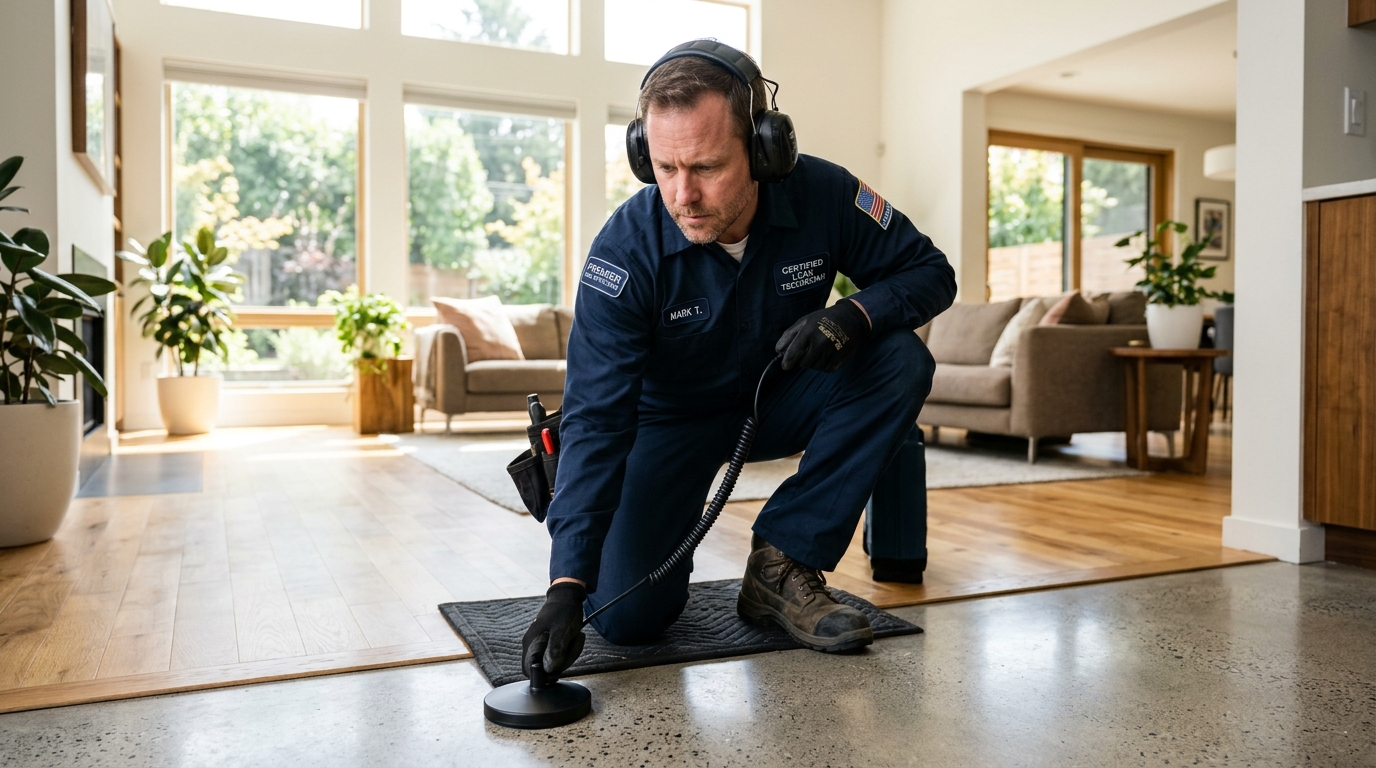
The Physical Mechanics of Sub-Slab Water Conduits
To understand how professional detection instruments work, one must understand the physics of pressurized fluid escaping into a porous subterranean matrix. When potable water under 60 PSI escapes through a microscopic pinhole or hairline fracture in a buried copper or PEX conduit, three physical phenomena occur simultaneously:
- Acoustic Friction Generation: Fluid velocity through an orifice creates high-frequency turbulence. As water collides with surrounding bedding gravel and compacted sand, it emits distinctive acoustic sound waves spanning the 200 Hz to 2,500 Hz spectrum.
- Conductive Thermal Energy Dissipation: In domestic hot water lines, escaping fluid at 120°F to 140°F warms the surrounding soil and foundation concrete through conductive thermal transfer. This heat radiates upward to the surface, creating an identifiable thermal footprint.
- Hydrostatic Differential Pressure Loss: When all plumbing fixtures are closed, an intact plumbing system functions as a closed hydrostatic circuit. A leak creates continuous fluid movement that causes the residential water meter dial to rotate and drops gauge pressure during isolation testing.
Certified diagnostic technicians exploit these three physical realities to triangulate the exact location of the pipe breach without inflicting structural damage on the building.
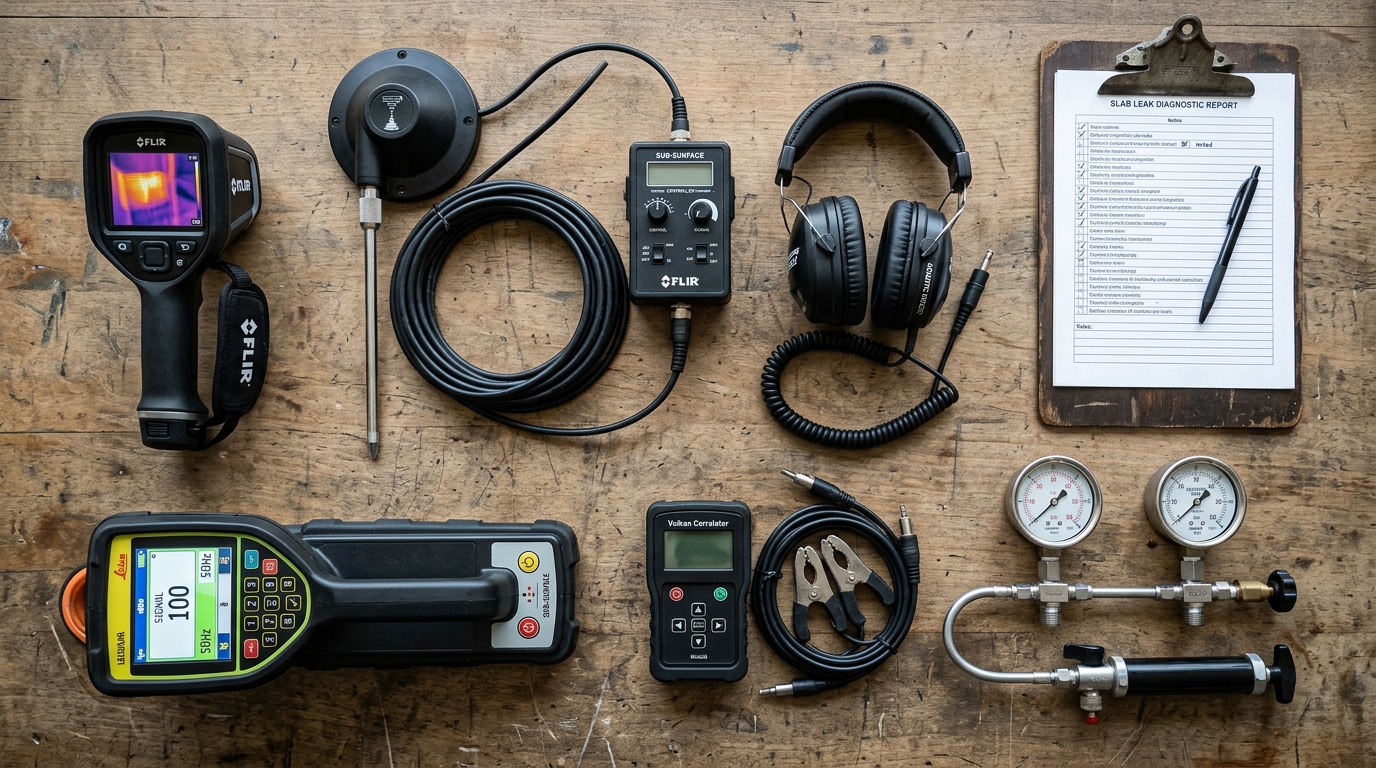
Primary Diagnostic Technologies Deployed by Specialists
1. Piezoelectric Ground Geophones and Acoustic Correlators
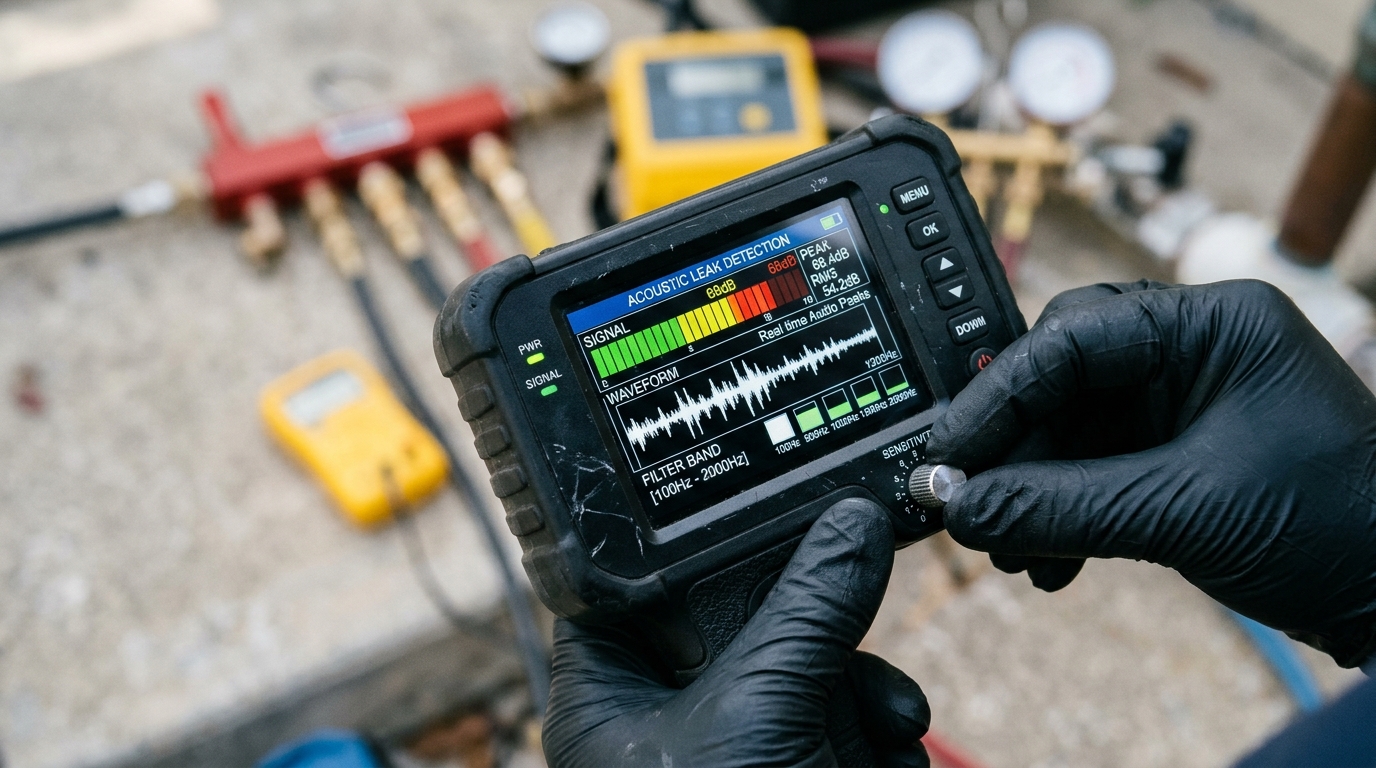
Acoustic detection represents the primary frontline tool in non-invasive leak isolation. Specialized ground geophones utilize piezoelectric ceramic crystals that convert physical surface vibrations into micro-volt electrical signals. These signals pass through digital signal processors (DSP) equipped with selectable low-pass, high-pass, and band-pass frequency filters.
By tuning the receiver to the acoustic signature of escaping water (typically 500 Hz to 1,200 Hz for concrete-embedded copper), the specialist filters out extraneous background ambient interference—such as street traffic, wind, electrical humming, and HVAC fan motors. The diagnostic console displays both numeric decibel gain and visual bar-graph resonance peaks, pinpointing the sonic epicenter directly above the pipe rupture.
2. Radiometric Infrared Thermography
When investigating hot water slab leaks, thermal imaging cameras equipped with high-resolution vanadium oxide microbolometers provide instant visual verification. These sensors register thermal differentials as small as 0.03°C. Escaping hot water elevates the temperature of the concrete slab and overlying floor finishes (such as ceramic tile, engineered wood, or luxury vinyl plank). On the infrared monitor, the rupture presents as an unmistakable radiant bloom, allowing technicians to map the path of hot water pipes across the home.
3. Tracer Gas Telemetry (Hydrogen/Nitrogen and Helium)
In deep foundations, thick commercial slabs, or scenarios where ambient background noise interferes with acoustic detection, specialists utilize non-flammable tracer gas mixtures (specifically 5% hydrogen and 95% nitrogen). Technicians isolate the suspect water line, purge residual water with dry compressed nitrogen, and charge the pipe with the tracer gas at controlled pressure.
Because hydrogen molecules are the smallest and lightest in the universe, they rapidly escape through microscopic cracks and migrate vertically through concrete pore networks. A specialized electro-chemical hydrogen sniffer swept along floor joints, baseboards, and grout lines detects rising hydrogen gas in concentrations as low as 1 part per million (PPM), confirming the leak's exact physical coordinates.
4. Electromagnetic Pipe and Sonde Locators
Pinpointing the leak's horizontal location is only half the battle; knowing the exact trajectory and vertical depth of the plumbing run is critical to executing a safe repair. Technicians attach high-frequency RF transmitters to exposed plumbing manifolds. An electromagnetic receiver traced across the slab maps the buried pipe's centerline and depth within a quarter-inch tolerance, preventing accidental contact with buried electrical conduits or structural post-tension cables.
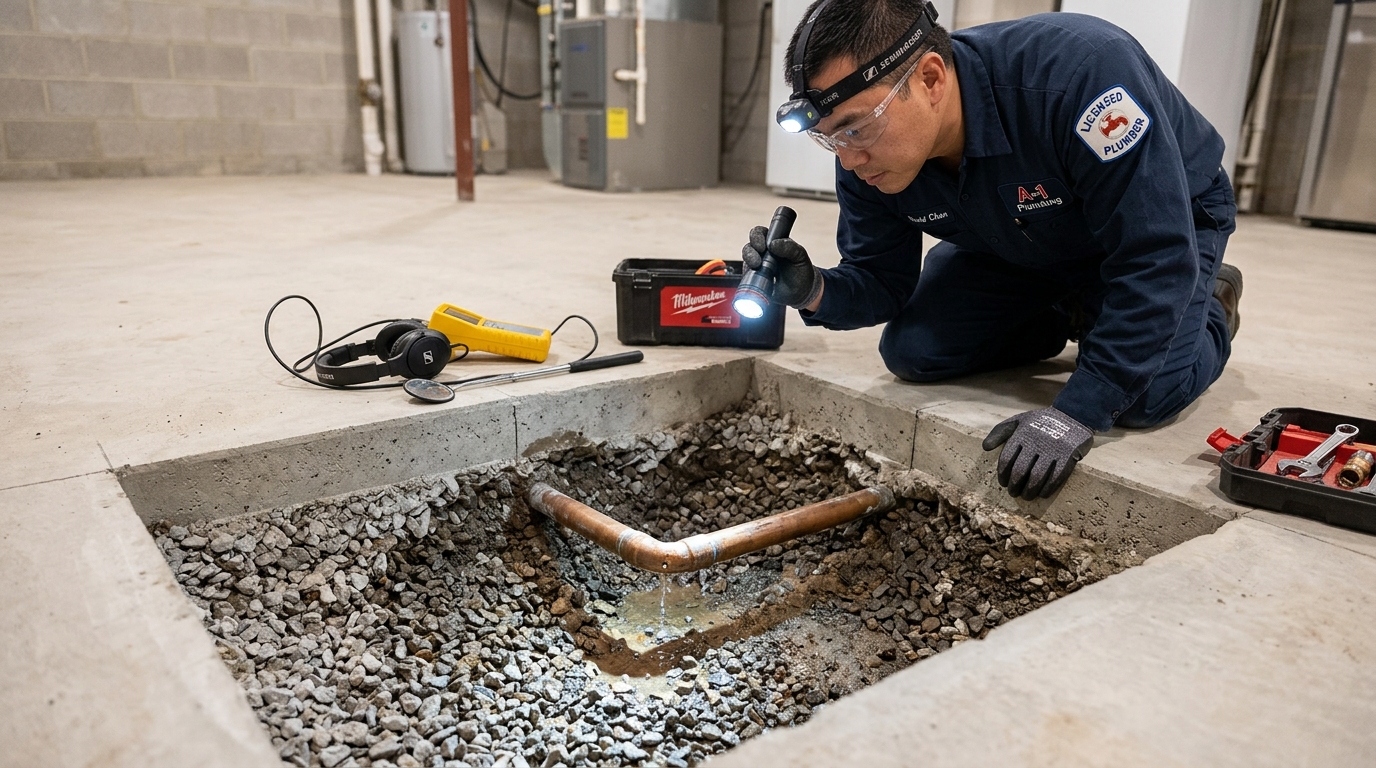
Step-by-Step Professional Leak Detection Protocol
Professional slab leak diagnostic procedures follow a standardized, methodical five-phase engineering protocol:
- Phase 1: Macro Isolation & Hydrostatic Pressure Testing: The technician connects precision liquid-filled test gauges to the plumbing system, records baseline municipal pressure, and isolates the main building shut-off valve. If pressure drops while all fixtures remain closed, a subterranean leak is mathematically confirmed.
- Phase 2: System Segmentation (Hot vs. Cold Separation): By isolating the cold water inlet valve on the water heater, the technician determines whether the breach resides on the hot water distribution loop or cold domestic service line.
- Phase 3: Electromagnetic Conduit Mapping: Transmitters trace the subterranean path of the affected piping loop, painting a precise chalk map of all underground lines across the home's flooring.
- Phase 4: Micro-Acoustic Grid Sweep: The specialist sweeps the acoustic geophone along the chalked pipe trajectory, taking sound readings every 12 inches to identify the focal point of maximum acoustic energy.
- Phase 5: Cross-Verification & Thermal Imaging: Thermal imaging or tracer gas sniffers confirm the acoustic findings, establishing secondary verification before any structural concrete opening is authorized.
Diagnostic Methodologies Comparison Matrix
| Technology | Primary Application | Accuracy Radius | Applicable Pipe Types | Relative Cost |
|---|---|---|---|---|
| Acoustic Geophones | High-pressure water leaks | Within 6 inches | Copper, Galvanized, PEX, CPVC | Standard ($350 – $650) |
| Radiometric Thermography | Hot water line ruptures & radiant floors | Within 8 inches | All pipe materials carrying hot fluid | Standard ($300 – $600) |
| Tracer Gas Telemetry | Micro-pinholes & low-pressure leaks | Within 3 inches | All potable water and radiant systems | Premium ($550 – $950) |
| Blind Demolition (Traditional) | Guesswork trenching without sensors | Unpredictable (Huge area) | Indiscriminate destruction | Extremely High ($2,000+) |
Structural Remediation and Long-Term Protection
Once a leak has been accurately located, property owners must choose between surgical localized repair, complete overhead line rerouting, or epoxy pipe relining. When dealing with properties where prolonged subterranean flooding has already compromised foundation stability or created exterior soil voids, property owners should coordinate with experienced foundation slab leak specialists to execute comprehensive structural restoration and re-establish soil bearing integrity alongside plumbing repairs.
Frequently Asked Questions: Professional Slab Leak Detection
A comprehensive non-destructive detection survey for a typical single-family home generally takes between 1.5 to 3 hours. Complex properties with expansive square footage, multiple plumbing manifolds, or high ambient exterior noise may require additional time for tracer gas isolation.
Under standard HO-3 and HO-5 homeowners insurance policies, the cost of locating the leak and tearing out concrete or flooring to access the pipe (the "access and tear-out" clause) is typically covered, provided the leak was sudden and accidental. The direct plumbing repair part (such as a $150 pipe coupling) is usually considered homeowner maintenance.
No. True professional leak detection is 100% non-invasive. Technicians place rubberized acoustic sensors on top of your flooring, scan with infrared cameras, and use electronic locators. No drilling, cutting, or demolition occurs during the diagnostic phase.
A pinhole leak is a microscopic perforation caused by internal electrolytic corrosion or exterior gravel abrasion, releasing a fine high-velocity spray. A pipe shear is a catastrophic structural break caused by foundation shifting or soil settlement, resulting in massive immediate water discharge.